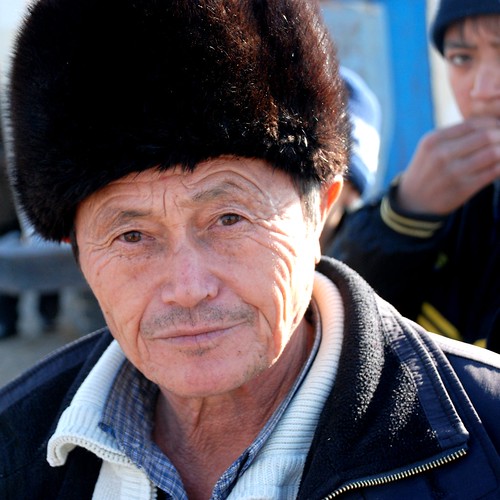
Tuesday, July 5, 2011

Indo-European genetic, cultural and linguistic influence on Altaic peoples

Though not yet common knowledge, it is becoming well known that Central Asia was inhabited by Caucasian skulled Indo-European speaking populations in ancient times.
In fact Indo-European speaking populations made it as far east as modern day China, Mongolia and Siberia.

The most notable Indo-European ethno-linguistic groups to roam the Eurasian steppes and grasslands were the Scythians and Samaritans who spoke languages belonging to the Iranic branch of the Indo-European language family.

Earlier I had assumed that Indo-European (IE) genes found in Central Asian Turkic and Mongolic populations was a direct result of the migration tides by Altaic peoples (which includes both Turkic and Mongolic peoples) across Eurasia and their forceful destruction/assimilation of the remaining IE peoples living there.

But according to a book I read on the Scythians written by Tamara Talbot Rice published in 1961, various Scythian graves excavated in Central Asia and the Eurasian steppes revealed a Mongoloid figure(s) placed next to the Scythian in the grave. The Mongoloid individuals revealed in the various graves next to the Scythians were probably spouses or slaves buried next to their "masters" to serve them in the next world.

There's another book on the Scythians that I am currently reading published in 1980 by Renate Rolle called the The world of the Scythians.
That book claims that excavations in the Kurgan reveal Scythians with more Mongoloid features.

This could be a clear indication that Indo-Europeans were mixing with Altaic populations as far back the first millennium BC.
The light skinned/haired peoples in Mongolia and Central Asia might be the result of this as opposed to Turko-Mongol tribes migrating into Central Asia and bringing back their IE mates to present day Mongolia. The Turko-Mongols never moved back to the Altay mountain region upon their migrations in the fifth and sixth centuries AD. They just kept moving West as far as the Black Sea region.

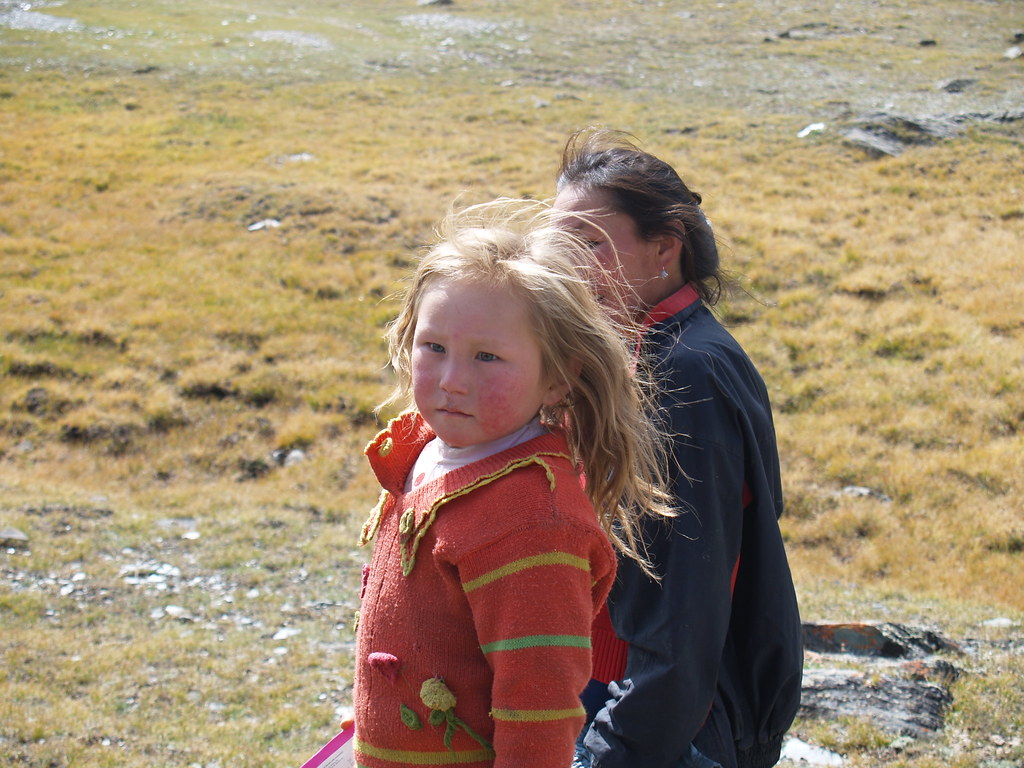
It was the Scythians who migrated as far as the Altay mountain region and left their genetic imprints there. This is the reason why I believe many Mongolian and Turkic peoples in Central Asia look like the blond Mongolian child pictured below:
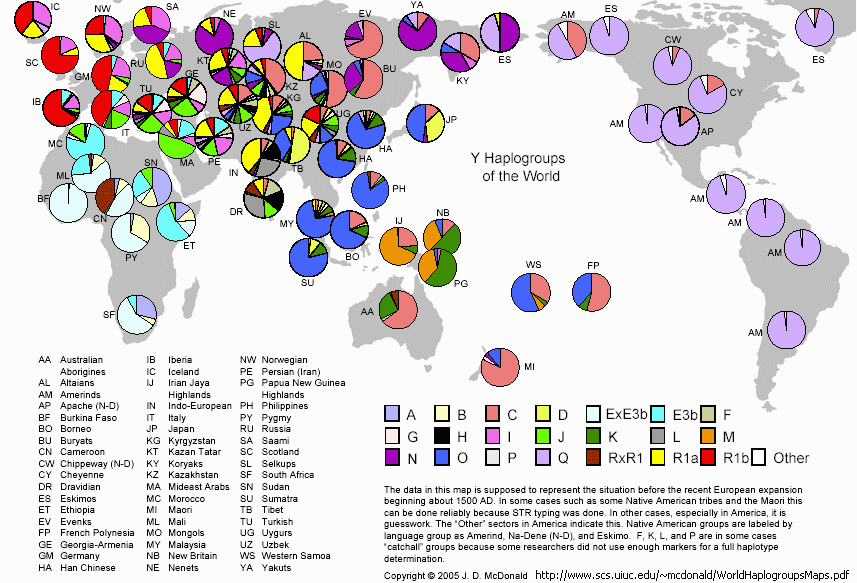
Even the Haplogroup map below shows larger genetic inputs of Haplogroup R in Central and Eastern Asia: (click on image to enlarge)
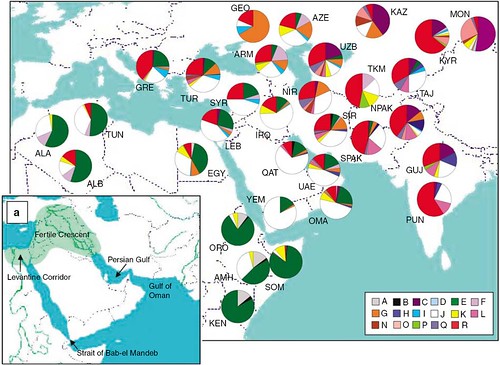
It should be noted that Haplogroup R and it's subclades have been associated with early Indo-European speaking populations and their descendants. The map of the Scythian inhabited territories coincides with high frequencies in the exact same regions: (click on image to enlarge)


All this is clear evidence of race mixing occurring between the Indo-European Scythians and Altaic populations in ancient times.
The Indo-Europeans, more specifically the Scythians went as far as the Altay mountain region and brought back ancient Altaic spouses and/or slaves with them when journeying across Central Asia.

Scythian royal family member ("Golden man") excavated in Central Asia:

Then towards the end of the first millennium BC, the Scythians started to disappear. As Tamara Talbot wrote in her book, the Scythians disappeared from the pages of history as abruptly as they appeared.
As I stated earlier, I had presumed the disappearance of IE languages and peoples in Central Asia to be the result of Altaic nomads who swept across the Eurasian wastelands, spreading death and destruction everywhere and that might be partially true, but not the only reason.

Indo-European genetic imprints in Altaic populations today might not be only because of Turko-Mongol assimilation, but rather Scythian incursions into the East of Eurasia.
The early Turko-Mongols might have been already carrying IE genes in them upon their sudden arrival from the Altay. Clearly they have been influenced by the Scythians in ancient times to have such enormous imprints of Haplogroup R and for Scythian grave mummies to show signs of Mongoloid features.

Horse domestication and usage is found amongst the Altaic peoples up till present day most likely seems to have it's roots in contact with IE nomads who journeyed east into Siberia and the Altay mountain region.
Horse domestication has long been associated with Indo-European peoples and many even blindly claim it to be an Indo-European invention.

Though I do not believe that the prehistoric Indo-Europeans were the only peoples or even the very first ones to be behind horse domestication, I still believe that they were amongst the first to be involved in such a practice.
The discovery of horses and chariot-like designs in Indo-European archeological sites are strong evidence that the IE peoples were amongst the first inventors of this practice.

It has been widely accepted that the domestication of the horse and invention of the chariot is the reason for the Indo-European language family having been able to cover so much landmass.
Grave excavations, artifacts and inscriptions indicate how important the horse and the chariot were in Indo-European cultures. Greek and Roman mythology are good example of the horses importance to Indo-European cultures and spirituality. Germanic mythology also shows the importance of the horse and it's usage to the Indo-Europeans.

Below is a horse and chariot symbol possibly from Germanic mythology:

Many sources that I have come across also claim early IE dialects having several terminologies for horses and horse domestication.
Horses were also often sacrificed and buried with their "owners" in Scythian culture. This is probably to accompany their "owners" into the next world. It is the usage of the horse that gave the Scythians and just about the entire Indo-Europeans such mobility across Eurasia.

Such usages of the horse and mobile vehicles attached to them is not as well noted by other races and cultures in ancient times as much as the practice has been associated with Indo-European peoples.
Of course in more recent centuries we've seen other races adapt to this practice such as the Semites and the Turko-Mongols. This is a cultural imprint left behind on them from contact with Indo-European peoples, most likely the Scythians.

Though the Altaic language family is relatively small compared to the Indo-European family in terms of numbers of languages and native speakers, it is still very comparable to IE in many other ways.
The Altaic language family covers plenty of landmass much like the IE family does. It also spread in much the same way across the Eurasian continent adjacent to it's original homeland (the Altay mountain region) going in the opposite direction like the IE family, except IE has it's presence on two sides adjacent to it's original homeland whereas Altaic has only one known direction going West and Southwestward of it's original homeland.

Refer to the following maps. A map of the Altaic languages subfamilies and where they are spoken:
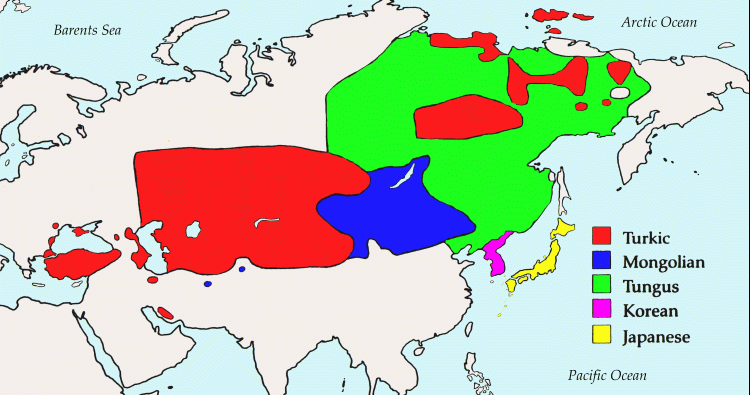
A map showing the spread of the IE languages:

The spread of the Altaic languages across the Eurasian continent, much like in the same manner as Indo-European was once again owed to mobility and transportation which was made available with the use of horses and chariots. Horse domestication and controlled breeding by Turkic peoples is described in this source.

The domestication and usage of the horses was a trait the Turko-Mongols most likely picked up from Indo-Europeans in ancient times.
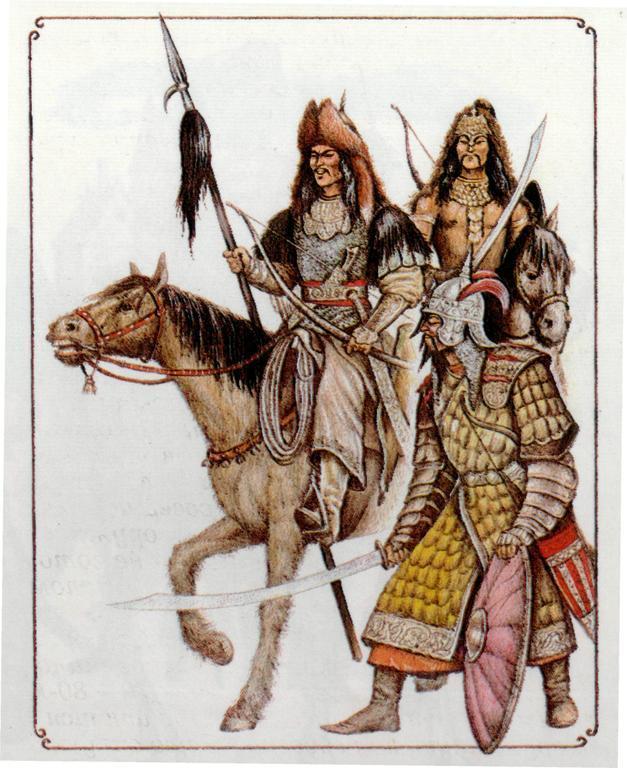
Horse domestication and usage was also successful with the Mongols and their rise to power in the 12th century under Genghis Khan. According to a documentary I once saw, the Mongols also switched horses at checkpoints to be able to cover vast distances.

Depiction of Tatars on horses:
Sources on Indo-European cultures throughout Central Asia as well as the Eurasian steppes such as this book summary mention the importance of the horse to ancient Indo-European peoples.

Horse domestication and usage is most likely another cultural trait picked up by Altaic peoples from the Indo-Europeans.

I was recently watching a documentary on Genghis Khan and the Mongols (I haven't finished seeing it) and it discussed Mongolian customs during the great Khans. The burial of horses, spouses, jewelry and other possessions into an important Mongol leader's grave sounded like a carbon copy of those described in Scythian customs. All of this is too similar to be coincidental.

Blood bothering is another practice reported amongst the Scythians and was also commonly found in the twelfth century Mongols, including Genghis Khan himself.

Another strong comparable cultural trait between Altaic and Indo-European peoples are astronomical symbols found amongst both cultures/spiritualities.
Take for example the sun and moon symbols found on these crosses flags of Mongolia and Kazakhstan: (click on image to enlarge)

They bear striking resemblances to astronomical symbols used by Indo-European peoples. Take for example this sun symbol from Roman mythology:
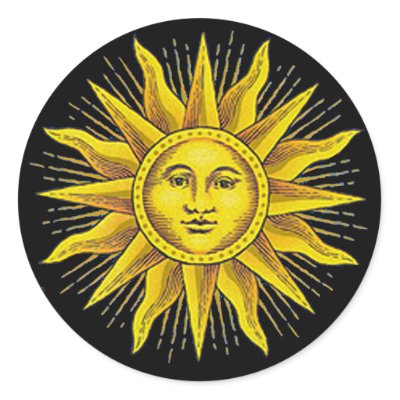
The differences are obvious, but the directional design of the sun is almost entirely the same as the sun designs of Turko-Mongol peoples.

Here are other symbols used by Indo-European peoples. The mythological creature and sun in the background are traditional symbols found in the cultures of Iranic peoples such as Kurds and Persians in this case:


The moon is also a comparable astronomical symbol between the Turko-Mongols and the Indo-Europeans as both civilizations have them displayed in a similar crescent shape.
Take for example this Greek crescent moon symbol representing the moon goddess from Greek mythology:

Here are some historic and unofficial flags of Turko-Mongol peoples that have astronomical symbols very similar to Indo-European ones:

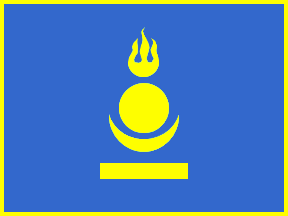
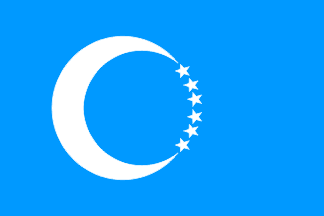
Click on image to enlarge:

I'm not trying to imply that Indo-Europeans were the first to practice sun and moon worship and that everyone else borrowed the practice from them. The worship of astronomical objects amongst humans is found in cultures throughout the world going back thousands of years.
This is only natural due to the fact that the living inhabitants on the surface of the planet Earth have been exposed to them since their very existence.

However the design of the sun and moon as well as other astronomical symbols in Indo-European cultures is depicted in a certain style more distinct from other cultures. If one looks at designs and depictions of the same objects in various unrelated cultures they vary and look very distinct.

For example if you compare the Valentine heart to that of ancient Egyptian depictions of the heart. The Egyptian depiction of the human heart is the same as the real heart, whereas the Valentine heart is imaginative and bears no resemblance to the actual heart.

Likewise there are cultures that depict astronomical symbols in different shapes and designs.
The similar directional designs in the examples I provided all seem to point to a common origin.

The presence of Indo-Europeans across the Eurasian steppes plus evidence of genetic influence alongside grave sites as far as the Altay is too big of a coincidence for the symbols of the Altaic peoples to resemble Indo-European ones.

The locations of such burial tombs are found in Kazakhstan and even further east in Siberia and Mongolia.
There is no doubt in my mind that there is a common source in such cultural practices in the peoples of the Altaic steppes, their relatives in Central Asia and those of the ancient Indo-Europeans.

On the linguistic side I have also found linkages. Many sources such as this one claim linkages between the Indo-Aryan languages and the Mongolic languages.
I've seen many comparisons between Hindi, an Indo-Aryan language, and Mongolian. I first presumed this to a another result of Scythian contact with Proto-Turko-Mongols since the Scythian language was an Iranic language.

The Iranic languages along with the Indo-Aryan languages as well the Dardic and Nuristani languages all constitute the Indo-Iranic language family.
The extinct Scythian language belonging to the Iranic subbranch of Indo-Iranic would technically be the closest language to modern Hindi spoken in the area of the Eastern Eurasian steppes.

But now it appears there is an even closer link which is not a Scythian source in this case. Sanskrit is described as "the mother of all modern Indo-Aryan languages."
Sanskrit has also been the sacred language of various cults/religions throughout much of South and Central Asia. It has often been the sacred language of Buddhism and the language of many spiritualities today dubbed as "Hinduism."

The vast majority of Mongolians today are Buddhist and Sanskrit appears to have been used for prayer by the Mongols for centuries. They might not use it today, but Indo-Aryan traces are found in Mongolian, most likely as a result of Sanskrit usage for religious services.

All of these are evidence of genetic, cultural, and linguistic influence of Indo-Europeans on Altaic peoples.

Sunday, May 22, 2011

There's no such thing as a "mixed language(s)" except possibly in extremely rare cases.

I pointed out in one of my other blogs that almost every living language in the world carries words borrowed from another language.
Languages that are perceived to be "pure" as in not influenced by another language, weather in vocabulary or any other area are extremely rare assuming they even exist.

Such "pure" languages would be considered extraordinary along with their speakers as well as the locations and environments they live in.
And even if such languages are found, they may show traces of influence from an extinct language/languages, discounting their strict "purity."

Likewise having heavy or light influences from other languages does not make the influenced language an "off-spring" of the influencing languages.
Even if the language that has borrowed vocabulary is related to the languages it borrowed from, it still does not constitute what many mistakenly see as "language mixing."

The reason why you cannot have a mixed language is because languages are not simply words. They are a strict set of rules and patterns with few exceptions depending on the language.
Even when you mix words from a different language in your phrase or sentence and think that you're speaking two or more languages together, you are mistaken. If you pay attention to the grammar, you will realize which language you are actually speaking regardless of which words you use.

It's usually the word order and usages that determine it. And even if you speak with a word order alien to all the languages that you are supposedly "mixing," it is still only one of the languages you're speaking.
Certain components you are applying in your phrase or sentence will be most applicable only in one of the languages that you are speaking.

For example, if you were to try and construct a sentence of English and French, you can only use one of the two languages' grammars and/or other key components, particularly syntax. This is because French and English mostly have distinct grammars that cannot combine.

This is true for just about every spoken on Earth. Combining words is just as far as one can get. And even when combining words, one has to ensure there is no grammar conflict between the word or words being used and the language it is being forced into.

And when there is a grammar conflict, the language using it has to exceptionally modify it's grammar to accommodate the borrowing word or to give the word some sense.
When that is properly done, the language borrowing the word and possibly modifying itself is the language being spoken.
This may appear to many as what they call "language mixing" but they will realize it is not such when they actually analyze the "mixed sentence."

The only way to create mixed sentences of two or more languages is speaking at least one phrase from each language.
If the phrases are completed and spoken in the appropriate grammars of their respective languages, you can produce a mixed sentence. But again, you are not mixing the two or more languages as many would mistake this process to be.

I read it is common for Arabic speakers from former French colonies to mix French with Arabic.
The same is true for many South Asians fluent in English and those who use English in everyday life. When Arabs from Lebanon or other former French colonies mix their Arabic with French, they usually speak sentences with phrases from each language.

For example, it is common for them to greet one another by saying "Kif Haq. Bein?"
Kif Haq= How is it going in Arabic.
Bein= Good/fine in French.

So the sentence consisting of a French and an Arabic phrase would come out as a mixed sentence. But the two phrases are complete and independent of one another. The Arabic phrase starts and ends with it's full message before the French phrase begins. This is an example of constructing sentences from two separate languages.

But the languages did not intermingle. They are very different in grammar and in key fundamentals. Language is more than just putting together words. It's the method of putting the words together. Those methods vary in each language. One cannot speak a language by memorizing their words and meanings but also by understanding their usages, how to correctly combine them and their exceptions.

Examples of appropriating a word(s) from a foreign language into the one you speak is when English speaking South Asians fit in English words into their sentences. This is true especially for many speakers of Sindhi, Punjabi and Hindustani (which is counted as both Hindi and Urdu).

At many times Westernized speakers of these languages tend to fit in English words into their sentence when speaking their language.
But even still they are using Indo-Aryan grammar upon the word they are using.

An example of using the English word "throw" in Urdu would be "Uos Ko throw kar low."
This technically translates to "throw that" or "throw it."

In English grammar the word throw is enough to be considered a verb form as a word on it's own. This is not possible in Urdu which requires the root word to combine with the meaning of doing something to create a verb. "Kar low" or "kar dow" literally mean do do it.
So when saying "Ous ko throw kar dow" or "Uos ko throw kar low" the person actually really speaking Urdu but adding an English word and slightly altering the grammar to give it meaning to the English word which would make no sense at all on it's own if used in Urdu.

As already mentioned, Hindustani cannot use a word in verb form simply on it's own. If the Urdu word for throw p/hayk, (pronounced p-h-ache) is used, then kar would not be used and the phrase would be "Uos ko p/hayk dow."

This again is not mixing languages, but simply adding words from one language into another. Two distinct languages cannot be combined or mixed.

In that way linguistics is very much like genetics. Genetics is also language but in a more physical form. This is why genetic relationship is the term used in comparative linguistics.

Two or more languages are distinct from one another as two or more species are from one another. The possibility of combining two languages into a "mixed" or "hybrid" language is as probable as mating two distinct species to produce a hybrid off spring(s).
If one were to try to combine English and German into one language, it would be like trying to mate a lion and a tiger. Both English and German are closer relatives than other Germanic languages as they belong to the Western Germanic subfamily.

Likewise lions and tigers are much closer to one another than they are to other cats such as lynx or domestic bobby cats.
I've briefly read and heard of cases of closely related species mating such as leopards with cheetahs or mules with donkeys. From what I learned, the offspring(s) was not very developed genetically. For instance they were unable to reproduce. That would be likely for most offsprings of inter-breeding amongst distinct species.

Their senses would likely be undeveloped. Their eyesight and reproducing functions would be weak. In short they would not be fully stable creatures with regular functionaries than of a normal off-spring of any species. The only chance of an inter-bred creature having the same characteristics as other normal beings is through mutation.

That almost never occurs. And if it does, it is not always positive. Likewise, it is very difficult construct a "mixed language" out of two distinct languages. One can combine certain areas of corresponding grammar but no more than that.

French and Urdu have certain areas of corresponding grammar. French adds the sound "er" to it's root words to create a verb(s) of imperfect present tense. Urdu similarly adds the sound "naa" to it's root words to create imperfect present tense as in "caat-naa" which means to cut.
In that case you could add the Urdu suffix for the French root word and vice versa. However, only people familiar or fluent in both languages would be able to make sense out of them if they were shown the comparisons.
That would probably be the closest thing to "language mixing." In many other areas French and Urdu grammar hardly correspond.

Going back to mixing two closely related languages like English and German, the result would be just like mixing the mule and donkey or lion and tiger. The "mixed language" would be highly undeveloped.
It's speakers would be able to have limited communication amongst themselves let alone outsiders. Though English and German have much in common grammatically, their differences are far too great for them to merge.

German has vowels such as Ö which is alien to English. English also has similar vowels alien to German speakers. Their grammars also differ in far too many areas. As an example "Sprechen sie Duestche" (pronounced "shpreken-zee-Dauitch") is a formal way of saying in German "Do you speak German?"

If "Sprechen sie Duestche" was literally translated into English word for word, it would translate to "Speak thy German?" in old English. Even in old English, that word order would make little sense. In modern English it would translate to "Speak you German?"
Technically an English speaker would understand the question if analyzed properly and the same is true for people speaking a "mixed language(s)."

But then the problem gets worse. Like the off-spring of two separate species, this "mixed language" would have no proper set of rules and would unlikely be sustainable.
It's speakers would have to constantly struggle in areas of speech that they have not touched before. They will be left guessing and trying to make up rules for this undeveloped language. This would make their situation only more difficult.

When they try to combine the same phrase or sentence from English and German, they will have difficulty deciding which languages' grammar to apply. Applying both will not work. The results would be something like "Sie sprechen Duestche" "Sie speak German" "Do Deutsche sprechen sie" or "Speak you German?"

Such phrases will make sense in neither languages. And even when the speakers of this "mixed language" manage to create any standardized grammar, it would still be limited to a few areas of conversation.
That's what happens to any "mixed language" when two or more distinct languages are applied. A language has a clear set of rules. Some languages have rules that limit their flexibility and thus are often considered unsophisticated or at least less sophisticated than other languages.

But regardless, each individual language has a strict set of rules. Once the speakers of a language (which is usually infancy in the case for native speakers) grasp the rules, they will be able to use the language in all areas of conversation. Even when learning new words the speakers learn can automatically determine their usages because the rules have automatically been established in their minds.

Such would be impossible when trying to combine languages into a "hybrid language."
Speakers would be left constantly trying to guess on the usages of words, phrases and sentences.

Another great example would be trying to mix Persian and Hindustani, both Indo-Iranic languages. Persian belongs to the Iranic subbranch while Hindustani belongs to the Indo-Aryan subbranch.

Hindustani distinguishes gender through verbs, tenses and possessive pronouns, while the concept of gender distinction does not exist in Persian or even in other Iranic languages such as Baloch.
So when expressing a verb using Persian and Hindustani grammar, the speaker will be stuck trying to determine weather to use the Hindustani gender distinctive verb or trying to use neutral gender in the case of Farsi.

If it is one or the other, then the phrase or sentence's grammar will come out as one language or the other. The speaker cannot pick both or neither.
Combining the two related but distinct languages will be as possible as mating a whale and a dolphin.

Languages again are just like species. Related languages are like related species. Similar, yet unable to fully reproduce with one another.

The only possibility of combining two or more languages is if their grammars are identical. It would not matter if the languages are related or not. If their grammars correspond in all fields, mixing them would not be as challenging. The only challenge would be deciding which words of which parent languages to use in which sections of the hybrid language.

Though I doubt the existence languages with identical grammars, especially unrelated languages and the process of combining them, theoretically it is possible.

The various Arabic dialects of the Middle East and North Africa are very distinct in pronunciation and vocabulary. However, they are still considered Arabic, so they may be able to combine with one another with little or no grammar conflict.

The same could be said for Yiddish and German and Hindi and Urdu. But in this case it is not as improbable since all the mentioned languages and dialects are from a common single language and closely related to their comparable counterparts.

In this way different dialects of the same language are like different races or breeds of the same species. We have many breeds of domestic cats, dogs etc.
Just as we have different races of humans who are still able to mate.

The same could be true for the Turkic languages of Central Asia that vary mainly in vocabulary and pronunciation, but more or less are the same in grammar. This is where linguistics and genetics contradict each another. While in linguistics you can theoretically combine two closely languages/dialects and create a sustainable off-spring, in genetics it would lead to disaster.

An inbred off-spring in any living species is unlikely to survive. And if it or they do, it wouldn't last for more than a few generations at the most.

The misconception of being able to mix languages or the existence of "mixed/hybrid languages" exists worldwide. Many ignorant and uneducated people believe in such phenomenon without realizing the actual circumstances of such a process.
The idea of mixed languages is also strong in politics and is often a tool for political propaganda.

English suffers from such misconceptions due to it's influence from Greek, Latin, French and other languages.
Most people don't pay attention to English loan words in French or in modern Greek. This is mostly out of sheer ignorance or also due to the fact they do not understand the concept of borrowed vocabulary.

However, English does not suffer as badly as Urdu in this case. Many Arab and Iranian racists have propagated Pakistanis to be culturaless Muslims with no language of their own. They see Urdu as nothing more than an "off-shoot" of their own languages. The same is true for Dari/Tajik speaking Afghans. The same propaganda comes out of provincial ultra-nationalists in Pakistan who claim Urdu to be nothing more than an artificial construct of Arabic, Sanskrit, Persian and Turkish.

They see it as a young and new language that is a predator in their homes. They see their languages as the older and more respectable languages and Urdu nothing more than a young, artificially constructed language and a weapon of the Punjabi elites who are conspiring to eliminate them and their cultures.

Never do these ignorant people stop to think of the thousands of Arabic and Persian loanwords words in Baloch, Sindhi and other languages of Pakistan.

There are even some but few Hindutva fundamentalists in India who see Urdu as a carbon copy of Hindi just by using vocabulary from Persian, Arabic and the Turkic languages using Perso-Arabic script.
They do not realize that much of the Persian, Arabic and Turkic vocabulary in Hindi was artificially removed by their leaders. Urdu actually stands in closer proximity to the original Hindustani language of the Mughals due to retaining most of it's vocabulary.

Even modern Hindi is often incomprehensible to many Indians, which is why Urdu is often used, but called Hindustani to avoid public backlash caused by the sensitivity. Sometimes both Hindi and Urdu are jointly used in the Indian media, but again called by the name Hindustani to keep it neutral.

Languages constantly borrow words from one another and evolve upon that, especially when they try to accommodate the words they are trying to assimilate.
And when they do not borrow foreign words, they often evolve on their own words. Very few languages have escaped evolution if any such languages still exist.

Languages often evolve both independently and under influence from outside words by trying to accommodate borrowed words into their grammar. But the misconception of "mixing languages" is all over due to these processes which are misinterpreted.

Very few people really mention the English influence on French or the Sanskrit influence on Arabic. Many Sanskrit and Phoenician words in European languages have been passed onto them through Arabic.
Yet nobody calls Arabic a "mixed language" or the European languages such as Spanish and English borrowing these words as "language mixing."

It all takes us back to politics and preferences. Languages that are seen as enemies or spoken by people disliked by another group of people, that other group of people then pull out the propaganda of "mixed language" as a way of discrediting that language and it's speakers.
But as explained, such a language does not exist and perhaps even never existed beyond theory.

Thursday, March 31, 2011

Possible origins of the Hazara people of Afghanistan

Many differing theories on the origin of the Hazara people span across historians and anthropologists. The most well known theory is that they are descendants of Genghis Khan and his army. This has also been claimed by many Pakhtuns (more commonly known in English as Pashtuns) who see them as outsiders in Afghanistan and mostly regard them with contempt.

However, the theory of them descending from Genghis Khan's hordes is denied by many Hazaras. Even the current Turkic speaking population of Central Asia who are almost entirely Mongoloid by race are wrongly perceived by many to be derived from the twelfth century Mongols.

This perception is wrong. The Turkic speaking populations actually descend from Proto-Turko-Mongol nomads who migrated out of the Altai mountain region in present-day Northern China, Mongolia and South Eastern Siberia between the sixth and eleventh centuries AD.
This is where I believe the Hazaras descend from.

The Turkic people of Central Asia do share a common ancestry with modern Mongolians and the Turkic languages/dialects they speak also together belong with Mongolian inside the Altaic language family.
And as mentioned these people migrated out of the Altai mountain region as far back as the fifth and sixth centuries into modern Central Asia which is partially how the Turkic languages split away from the Mongolic languages of which Mongolian is one of.

Genghis Khan's army simply incorporated much of Central Asia into his empire during the twelfth century AD. So the common ancestry between Central Asia's Turkic population as well as their languages' distant relation to Mongolian is the source of their similarity to modern Mongolians, not Genghis Khan's military colonizations.

The main difference between Hazaras and Turkic peoples of Central Asia is that the Hazaras speak Dari, an Iranic language almost identical to Farsi.
Another but less noticeable difference is that the Hazaras are found mainly in Afghanistan as well as some in Pakistan and even fewer in Iran. The Turkic Uzbeks and Turkmens are also found in Afghanistan, but are only small minorities there and found mostly in Central Asia.

My main reasons for them descending from ancient Turkic tribes is that the Turko-Mongols were in Central Asia and modern Afghanistan for over a thousand years.
Also the Persian dialects spoken in Afghanistan were brought through conquest because since ancient times various parts of Afghanistan and Pakistan were under Persian rule starting with the Achmemenid Empire in ancient times and was reinforced during the Sassanid period in the third century AD.

The Persian language spread much throughout western Afghanistan all the way up till the Pamir Valley.
It is spoken in these areas till this day though in different dialects such as Tajik or Dari. As the ethnic map of Afghanistan pictures below, these are the areas the Hazaras inhabit in modern which would be my best explanation as to why the Hazaras speak an Iranic language today:


If the Tajiks living as far away as the remote Pamir Valley and beyond into Tajikistan are speaking Persian today, then the strongest probability of the Hazaras speaking it is due to direct contact with the Persian armies who occupied the region that they live in as the above map also shows.

But various Persian occupations of modern Afghanistan predate Genghis Khan's conquests by centuries. So there could not have been such a strong contact between Persians and Hazaras if the Hazaras came as late as the twelfth century AD.
This makes the case stronger for them being in Afghanistan at a much earlier period dating as far back as the sixth century.
Additionally, most portions of Afghanistan came under Turkic rule in the eighth century and again by Persian-Turkic Ghazvanids in the ninth century. All this happened centuries before Genghis Khan was even born.

I also want to touch more on the racial component. Though I am unable to find an accurate haplogroup map of Afghanistan or Central Asia, the appearance of Hazaras also show a closer affinity with Afghanistan and Central Asia's Turkic populations.

The Altaic peoples east of the Caspian Sea basin might be mostly or almost entirely Mongoloid, however they show significant European features in them.
It is well known that before the Altaic migrations started in the fifth and sixth centuries AD, much of Central Asia was inhabited by scattered white populations mainly of Indo-European (IE) descent though there is also the possibility of extinct peoples from the Caucasus. By white I mean white skin, light hair/eyes and Caucasian skull.

The best known Indo-European sub-races in Central Asia were the Scythians. Many tombs found in China, Mongolia and Central Asia contained these extinct IE peoples' bodies. The IE peoples migrated as far as the Tarim desert and the Altai mountain region where their graves and racially mixed descendants are still found.

These descendants are hybrids of the migrating Turko-Mongols mixing with the ancient white populations of Central Asia and that is why many of them have light hair and eyes.
This trait is commonly found in the Hazaras. The Hazara child pictured below is just another example of this:


I believe that this influence in the Hazaras are a direct result of ancient contact and mixing between IE tribes and Turko-Mongols. These IE sub-races were extinct far before the twelfth century, so the possibility of Mongols picking up this gene at that time would be close to impossible. I would not believe that these traits were a result of Hazaras mixing with whiter populations of Afghanistan such as the Nuristanis. Not on a large scale anyway. Otherwise we'd see plenty of or even most Nuristanis today with Mongoloid features.

Many Mongols also have this feature too since the IE Scythians had a strong presence in Mongolia as seen in this Mongolian girl pictured below:


This is most likely an isolated area in Mongolia. Most of the Mongolian population even today remains mostly isolated so it's likely those Mongolians with traces of IE genes did not mix with other Mongol tribes.
But such a trait save for the blond hair is quite common amongst the Hazara population as well as Central Asian Turkic peoples. Massive race mixing should have occurred in Central Asia to have these significant white traits till present day amongst mainly Mongoloid populations.

By the twelfth century, there was absolutely nothing left of Central Asia's white populations as far as I can tell save for their living descendants who are mostly Mongoloid.
So for Hazaras to be of twelfth century Mongolian descent and living in a multi-ethnic country like Afghanistan while still showing signs of white features, the Mongolian hordes would had to have been mixing with white populations. But the problem is the whites of Central Asia were extinct by then so where did they pick up these white genes?

My most reasonable explanation is that they did not descend from Genghis Khan's army. They may share a common origin with the Mongolians going back more than a thousand years- like Central Asian Turks, but definitely did not descend from them.

The word Hazir means a thousand in Persian similar to Hazar in Urdu. This is also referred to Genghis Khan's army of one thousand. If this was root for the name for Hazara, it is most likely that they served in Genghis Khan's army. Most of Central Asia was under Mongol rule in the twelfth century and had Turkic populations serving their armed forces, so the probability of the Hazaras serving in Genghis Khan's army is most likely.

Central Asia was the heartland of more pure breed IE racial types as opposed to the Iranian plateau or the Indus Valley in Pakistan where Iranics and Indo-Aryans were already mixing with native Elamites, Dravidians and others; thus altering their gene pools.
Only isolated areas of Iran, Tajikistan, Afghanistan and Pakistan show more pure breed IE sub-races.

Even this haplogroup map shows the IE haplogroup R and it's subclades at close to zero levels in the Mongolian population whereas Central Asian populations still have much larger traces of it.
Again, where did Hazaras suddenly pick up such a significant trace of IE genes in their gene pool if they descend from Genghis Khan's army?

Though there might have been a Mongolic language found in a few Hazara tribes towards Herat, this particular tribe may have picked it up as opposed to the rest of the Hazara population.
Mongolian influence may have occurred on the Hazaras but it also occurred on other populations such as the Pakhtuns as pointed out in this article. There are also Pakhtuns who exhibit Mongoloid influence in their physical appearance, though not that very many.

Even the light skinned and light haired Mongolians probably have these genes due to being isolated from the rest of the Mongolian population. Mongolia is a very sparsely populated country of nomads even today and has an extremely low birthrate, another sign of less race mixing.

In this post I want to conclude my belief that the most likely origins of the Hazaras are in the earlier waves of Turkic nomads who spread throughout much of Central Asia and dispersed much of it's white population and assimilating the remainders into their own race. They do not descend from Mongolian armies that came later in the twelfth century, much after the first Altaic migrations started and probably even ended. Due to Persian influence over Afghanistan prior to the Mongol invasions, the Hazara adopted the Persian language and eventually developed their own dialect.

If Uzbeks, Turkmens, Kazakhs can live in Central Asia for over a thousand years and show more European influence in their gene pool than the Mongolians do, then why can't Hazaras who live on the other side of the Mongolians with the Turkic people separating them by thousands of miles.

There are also theories that the Hazara descend from Chagatai Turks who lived more towards China. The Chagatai Turks were partially derived from the Tocharians, the lost IE people who settled in the Tarim desert in China and who's descendants amongst the Turkic Uighurs are very much visible today. I do not find that a very much credible theory either, though I do not rule it out.

Still, that theory is much more probable than Hazaras descending from Genghis Khan's army.

Wednesday, March 23, 2011

Racial affinity vs linguistic affinity

Most people including many anthropologists and linguists have assumed linkages between races on the basis of common linguistics. It's not only that, but racial similarities between certain ethnic groups usually goes ignored because the languages they speak are much more distantly related or in some cases not related at all. While such assumptions are understandable, they are not always correct.

In this post examples of common racial affinity can be compared to common linguistic affinity.
Let me compare two separate races which are unrelated but at the same time speak languages that are closely related to one another. Below is a picture of a Turkish person from Anatolia:


People from Turkey speak Turkish which belongs to the Western Oghuz Turkic subfamily of languages.
Compare this Turkish man to the Uzbek individual below and notice the vast racial difference between the two:


While racially they may seem very distinct (and perhaps culturally too), the languages they speak are still in fairly close proximity.
Though a separate language of it's own from Turkish, the Uzbek language is still closely related to Turkish, both belonging to the Turkic family of languages inside the larger Altaic language family. The chart below maps out the Altaic family, though not very accurately: (click on image to enlarge)


After looking at the chart, compare the Uzbek man pictured above to this Mongolian man pictured below:


His closer resemblance to the Mongolian points to a closer racial affinity between Central Asian Turkic speaking peoples and Mongolians. This is despite Central Asian Turks speaking languages/dialects very similar to that of people from Turkey and Azerbaijan. Most people from Turkey and Azerbaijan look nothing like Central Asian Turks in terms of skull structure and are racially unrelated to them, though there is some Central Asian genetic influence in the Turkish and Azerbaijani populations.

While comparing the racial similarity between the Uzbek to the Mongolian, the vast distinct relationships between their languages should be observed.
Mongolian belongs to the Mongolic branch of Altaic languages as the chart above shows. Neither Mongolian or any other Mongolic languages have common intelligibility with the Turkic language aside from perhaps common cognates.

This is an example of races/ethnic groups having common racial affinity (Central Asian Turks to Mongolians) while the languages they speak are very distant from their close racial relatives languages to those languages of peoples who have racially very little or nothing in common with them (Turks from Central Asia to Turkic speaking peoples from Azerbaijan and Turkey).

There are many reasons for such cases to occur. It really depends on the circumstances of each case. At many times language shift occurs by one ethnic group to a language related to their own or at many times unrelated to their own. When it goes on for generations, the ethnic group eventually evolves the language(s) it picked up into a dialect of it's on and then later on into a completely separate language.

Such happened in the case for Turkey and Azerbaijan when Oghuz Turkic armies came from Central Asia and colonized Anatolia and the Caucasus. They also left genetic imprints, but not significant enough to be noticed by general observations. Very few people from Turkey and Azerbaijan show Turko-Mongol ancestry, but it doesn't mean it's not there.

The infamous Turkish singer Mustapha Yildizdogan is perhaps the best example of Oghuz genetic influence in Turkey.
A good way to catch Oghuz Turkic imprints in the two countries is to find distributions of Haplogroup Q on their maps.

Another example of this is comparisons between Indo-European speaking populations of Southern Central Asia and the Middle East to East European populations.
The closest racial relatives of Eastern European peoples are actually situated in South Central Asia and the Middle East, not in Western Europe. Strong evidence in their common origins are found in their related languages as well as some similar features, but most strongly in the common Haplogroup R1A that they belong to.

Western Europeans also carry this haplogroup, but I believe it was mainly due to mixing with Eastern Europeans.
While many Indo-European (IE) speaking peoples of Asia are related to Eastern Europeans going back thousands of years, the languages they speak are very distantly related to the languages of Eastern Europeans. Most Eastern Europeans save for Romanians speak Balto-Slavic languages, while most IE speakers in Southern Central Asia and the Middle East speak Indo-Iranic languages.

The Indo-Iranic language family is divided into Iranic languages, Dardic languages, Indo-Aryan languages and a few individual languages of the family belonging to no subbranch said to be spoken in the remote mountain regions of Northern Pakistan and Eastern Afghanistan.
Click here to view a full chart of the Indo-Iranic language family.

At the same time, there are plenty of peoples in the region who speak IE languages (mostly Indo-Iranic) but are not of IE descent and of different origins.
However, these non-IE origin peoples of Southern and Central Asia speak languages closely related to those who are of IE descent. I will cover examples of these, but first I'd like to compare between IE peoples in Asia to their distant Eastern European relatives.

Two Pakhtun (also spelled Pashtun) individuals from Northern Pakistan:


The majority of Pakhtuns do not display similar characteristics to East Europeans but a large and significant minority of them do.
Compare the faces of those Pakhtuns to that of this Belorussian man:


The Kalash of the Chitral Valley in Northern Pakistan can also be comparable to Slavs since they absorbed the least non-IE genes and lived mostly in isolation:


Here is a picture of two Tajik girls from the northernmost of Afghanistan:


The strong resemblance between these various Indo-Iranic peoples towards Eastern Europeans is not coincidental. These people are distantly related to Eastern Europeans. At the same time, while the languages spoken by these people are related to the Balto-Slavic languages, it is a very distant relationship. Even amongst each other as well as themselves, the Baltic and Slavic languages are barely understandable towards one another's speakers.

The same can be said for Indo-Aryan, Dardic, Iranic and other languages within the Indo-Iranic family. Some of these languages such as Farsi and Bengali have even lost the gender distinction trait very commonly found in Indo-European.

Despite the distant linguistic relationship between these IE peoples in Europe and Asia, they are genetically closer to each other than they are to other IE speaking people in Europe as well as IE speakers Asia who are not of IE descent.
Examples of IE speakers in Asia of non-Indo-European descent are the Sinhalese people or the Bengali people. Though some people in these ethnic groups are of original Indo-Aryan stock, the vast majority of these populations are Indo-Aryan mostly by language. This is due to Sanskrit speakers spreading throughout the subcontinent and few of their remaining descendants can be found amongst these ethnic groups.

Typical Sinhalese people:


This is another of many examples where we have distantly related peoples and languages but sometimes at closer linguistic affinity with non-related races.

Another and more obvious example is the Finnish peoples genetic relationship to other Germanic populations but their linguistic affinity with other Uralic populations, most of whom are of non-Germanic and non-IE descent.

This Finnish girl looks mostly indistinguishable from an average Scandinavian or any Northern European for that matter:


The language she speaks (Finnish) is unrelated to the Germanic languages of Scandinavia or any Indo-European language.
Finnish is a Uralic language that originates in the Ural mountain region in Siberia alongside other Uralic languages, most of which has speakers racially/genetically unrelated to the majority of Finns.

The Finnish girl has no linguistic affinity to most other Europeans, unlike the two Sinhalese people pictured above who speak, Sinhalese, an Indo-Aryan language which belongs to the same Indo-European family as most of Europe's languages.
But at the same time those Sinhalese people have no affinity towards Europeans racially, whereas the Finnish girl is more or less the exact same race as other northern and western Europeans.

There are some Finns who display higher Uralic and Siberian genetic influence (higher cheek bones, wider eyes etc.), however the majority of them don't.
Below are pictures of Komi people. They are a Uralic people, mainly of non-European stock, but speak a language closely related to Finnish:


Here is another group of Komis. These ones show more Europid influence in them:


The Komis live in the Russian Federation. It is important to note that many peoples of the Russian Federation including Slavic, Finnic and Turkic peoples have large inputs of Scandinavian admixture in their gene pools.
The northwestern parts of the modern Russian Federation was home to various Scandinavian peoples before they became assimilated mostly by migrating Slavs as well as Turkic tribes.

Today Scandinavian features are most commonly found in these areas. The examples provided above are few of many cases when comparing racial and linguistic affinity between various peoples across the world. Any questions or misunderstanding should be posted in the comments section and I will try to answer them as best as I can or clear misconceptions.

Sunday, September 5, 2010

The Hunza of Pakistan and ancient Proto-Balkan-Caucasian peoples

In the past two years I had been reading many theories about the existence of a proposed family of Dene'-Caucasian languages.
Many theories of Proto-Caucasian (Caucasian as in people of the Caucasus see my other post) peoples and languages being spoken across Europe prior to the Indo-European migration which is believed to have occurred sometime during the fourth millennium BC onwards.

Prior to this time period in human history, little has been known about Europe until new research emerged about the possibility of Proto-Caucasian languages being amongst the many diverse language families spoken in the region of which may have been survived by Basque.

Many recent hypothesis suggest Proto-Caucasians languages and peoples populating areas of Europe. Certain linguistic theories have also linked the Burushaski language of hypothetical Caucasian families that also include Basque.
These hypothesis, though not proven lead me to a theory of my own. Despite lack of genetic evidence to support it and being doubtful of genetic results since most DNA tests on the Hunza populations seem show them to be related to the rest of Pakistan. I theorized that for the Basque and other extinct Caucasian languages to be spoken in Europe, a mass set of migrations must have taken place.

Thousands of years before the rise of the ancient Indo-Europeans, Proto-Caucasian tribes left their original homeland and moved westward and possibly southward since there are theories that the Sumerian language may be related to modern Caucasian languages.

But amongst these Proto-Caucasian migrations, a tribe or small set of tribes somehow ended up moving eastward. There are many cases of small populations migrating in opposite directions of the larger family, such as the case of the Tocharians who are said to be a Proto-Celtic tribe ending up in the Chinese desert instead of going along with the rest of the Indo-European migration.

If an established link is found between Basque and modern Caucasian languages as well as Burushaski and Ibero-Caucasian, then my theory is that the Hunza were a lost ancient Proto-Caucasian tribe that settled in Pakistan many hundred perhaps thousands of years prior to Indo-European domination in most of Eurasia.

Perhaps the Hunza are not descendants of these people as per most of the genetic evidence, but the language they speak may have come through a Proto-Balkan-Caucasian tribe that settled in Pakistan.

The Hunza are amongst the fairest people in Pakistan and bear a closer physical resemblance to Caucasian and European populations than to most Pakistani populations despite being closely related genetically; hence they might not be related to the people of the Caucasus genetically, but rather a people who inherited a Proto-Caucasian language due to nomadic settlements.

Or the alternate scenario could be that the Proto-Caucasians are the ancestors of the Hunza and absorbed outside genes as race mixing occurred.

Random migrations in ancient times may have led these Caucasians to enter the Indus Valley many thousands of years ago.
Only further research will reveal what the world was like prior to massive expansions and dominance of the speakers of many language families today, primarily Altaic and Indo-European.

Monday, March 1, 2010

"Dark-skinned" immigrants targetted in Russia

Frequently we hear of racist attacks against Central Asian and Caucasian (Caucasian as in people from the Caucasus) immigrants in the Russian Federation.

Alot of the times reports from agencies and newspapers state that these people are targeted because of their Asiatic looks or their "dark looks."
The first statement is more or less true since the modern-day inhabitants of Central Asia are predominantly Mongoloid, save for a few pockets of European migrants/settlers and Tajiks who seem to be predominantly Caucasoid (Caucasoid in this case refers to skull type).

The second statement is somewhat absurd and ignorant. Aside from many Tajiks, the people of Central Asia and the Caucasus are far from being "dark-skinned" people. Most of the Central Asian immigrants are Mongoloid typically with yellow skin. The immigrants from the Caucasus are predominantly white people ("white" in this case refers to physical appearance) and are indistinguishable from the average European population most of the time.

Below are pictures of Azerbaijanis. Can any "dark looks" be found in them?


Most of Caucasian peoples culture, linguistics and genetics differ from the Europeans, but in appearance, the vast majority of them except for a few mixed ones are as white as Europeans, with a huge percentage having blond hair, blue eyes. Others have red, brown hair with green eyes or blue eyes.
Where are the "dark looks?"

Even the Russian Neo-Nazis who target them, use the term "black" for the immigrants. The whole truth is that the "black" label is applied to people of non-European ethnicity which includes Chinese and other eastern Asian immigrants of non-European origins.

Being a blond-haired, blue eyed Lezghin or Azerbaijani makes no difference to the Neo-Nazi attackers.

Azerbaijani musicians:


Azerbaijani soldier:


Either the media misinterprets this "black" term or out of ignorance leads people to believe that anyone originating outside of Europe is always "dark"/non-white.
A lot of reports also claim that immigrants are prey to attacks due to their non-Slavic appearance.

This is a true statement as well. Though Slavic peoples, Western Europeans and Caucasians are of the same skin complexion, their facial structure generally gives out their racial identity or at least a clue of it.

But the main point is that the people of the Caucasus are predominantly white just as Slavic peoples and other Europeans.
The darker Caucasians are a result of mixing with darker invaders in the Caucasus such as Arabs and Persians.

To label all the Caucasians as "black" or "dark" on the basis of a handful is absurd. By the same contrast, Caucasians could also label Russians as "black" because of Russians like Alexander Pushkin.

Some more Azerbaijanis. Their appearance matches that of most other peoples of the Caucasus:


Is Persia Iran?

For a long time many people used to think of Persian and Iranian to be of the same meaning. But now with the age of the Internet and free flow of information, most people know this to be completely false. For Persian to be the same is Iranian would be like saying Punjabi is an equivalent for Pakistani.

Like Pakistan, Iran is a multilingual country with Persians constituting a little over half the population.
Many people also believe that Persia is an ancient name of Iran. The reason why the name Iran was not used before is because the modern state of Iran was not established before 1935.

Prior to that Iran's Fars province was known as Persia, but the other provinces of Iran home to the various non-Persian populations are not Persia.
It's accurate to say that Persia is not really an ancient equivalent of Iran, but rather a province of Iran; hence Persian history is a part of Iranian history now that Persia is a province of Iran.

Though the name Persia was used in Western terminology, it has it's roots in present-day Iran. The name is said to be derived from the word "Fars" or better the Fars province of Iran. This word sometimes pronounced as Pars (also used to refer to Zoroastrians in Pakistan "Parsi") hence the word "Persia" developed. The word Persia does not refer to the entire Iran. It specifically refers to the Fars province.
Fars=Persian person. Farsi=Persian language. Iranian=Person from Iran be it Kurd, Azeri, Baloch, Fars/Persian etc. Fars province of Iran=Persia.

There was a paragraph I found on http://www.iraninfo.dk/multimedia-videos/videodirectlink-70.html (the site no longer seems to exist) which I wanted to share:

Fars is one of the 30 provinces of Iran. It is in the south of the country and its center is Shiraz. It has an area of 122,400 km². In 1996, this province had a population of 3.8 million people, of which 56.7% were registered as urban dwellers, 41.0% villagers, and 1.4% nomad tribes. Nominally, F?rs is the original homeland of the Persian people. The native name of the Persian language is Farsi or Parsi. Persia and Persian both derive from the Hellenized form ?????? Persis of the root word P?rs. The Old Persian word was P?rs?. Fars province was originally called Pars after the Persians(pronounced Pars in Persian) which settled there. After the Arab conquest of Iran it was renamed Fars. A branch of the Indo-Iranians migrated to Fars in the second millennium BC. The ancient Persians became the rulers of a large empire under the Achaemenid Empire in the sixth century BC. The ruins of Persepolis and Pasargadae , two of the four capitals of the Achaemenid Empire, are located in Fars. The Achaemenid Empire was defeated by Alexander the Great in the fourth century BC. The Seleucid Empire was defeated by the Parthians in 238 BC. The city of Shiraz is located in Fars.